Coal DMO Increased but Supply Remains Tight for Power Plants
Sun 01 Mar 2026, 01:13 AM
Share
Indonesia remains a major player in the global coal trade. In 2025, Indonesia accounted for approximately 43% of the world's coal trade, with national production reaching 790 million tons.
From that total, the Domestic Market Obligation (DMO) allocation was recorded at 254 million tons, or approximately 32% of the total production.
However, despite this dominance, several domestic coal-fired power plant (PLTU) operators have reported coal reserves hovering around 10–15 Days of Operation (HOP), approaching the minimum safety limit for the system.
In the current situation, the government plans to adjust production quotas in the 2026 Work Plan and Budget (RKAB). Coal production is set to be reduced to approximately 600 million tons, while the DMO portion will be increased to around 30% of total national production.
In line with this, the Directorate General of Mineral and Coal at the Ministry of Energy and Mineral Resources (ESDM) is also drafting a new Ministerial Decree to adjust changes to the RKAB mechanism, which will now apply annually rather than every three years.
Minister of Energy and Mineral Resources Bahlil Lahadalia stated that the policy to reduce production is being implemented to balance the global supply, which is deemed excessive, and to stabilize prices.
"The result? Supply and demand were not maintained, and eventually, coal prices fell. The Director General of Mineral and Coal is recalculating. What is clear is that it will be around 600 million tons. Around that. Coal. More or less. It could be less, it could be slightly more. Note that it's 'more or less'; don't say exactly 600," Bahlil said during a press conference in Jakarta on Thursday (Jan 9, 2026).
DMO Increases to 30%, but Supply Stalls
Regulation-wise, the coal DMO obligation refers to Law Number 3 of 2020 concerning Mineral and Coal Mining. Technical provisions are further regulated through ESDM Ministerial Decree Number 13 of 2022, which mandates that at least 25% of production be allocated for domestic needs, including power plants, cement industries, and fertilizer plants.
In its latest development, the Ministry of Energy and Mineral Resources (ESDM) confirmed that the DMO portion this year has been increased to 30% of total national production. Deputy Minister of ESDM Yuliot Tanjung stated that based on demand calculations, domestic supply should be sufficient.
"Last week, regarding the availability of primary energy—especially coal—we coordinated with PLN, and it was conveyed that for DMO, around 30 percent of total production is used for domestic power plant needs. So, based on demand, it should be enough," Yuliot said when met at his office in Jakarta on Friday (Feb 27, 2026).
Production and DMO Trends Continue to Rise
In the last five years, national coal production realization has jumped significantly:
2020: 564 million tons (DMO 132 million tons)
2021: 614 million tons (DMO 133 million tons)
2022: 687 million tons (DMO 216 million tons)
2023: 775 million tons (DMO 213 million tons)
2024: 836 million tons (DMO 233 million tons)
2025: 790 million tons (DMO 254 million tons)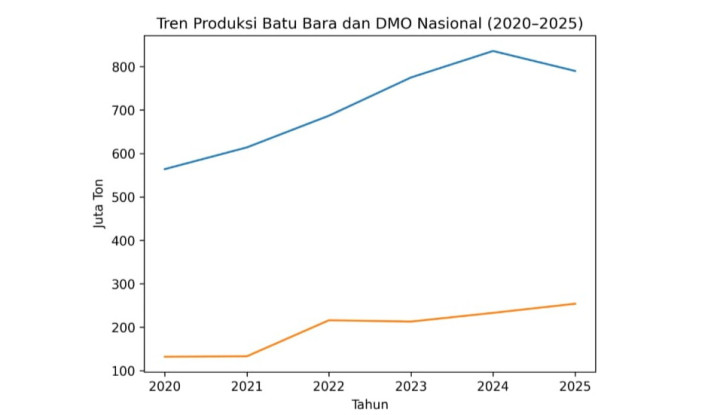
In absolute terms, the 2025 DMO volume is nearly double that of 2020. Both the absolute volume and percentage of the DMO have increased significantly, even reaching 32% of total national production in 2025—higher than the minimum allocation of 25%.
Field Facts: Slim Stocks
At the power plant operator level, stock conditions are reported to be within safe limits but at minimum levels. Kanapi Subur Dwiyanto, Director of Planning and Marketing at PLN Nusantara Power Services, admitted that supply constraints are occurring at both PLN and Independent Power Producer (IPP) plants.
"Everyone is now constrained, both at PLN and IPP plants, but it is more difficult at IPPs. Thank God, inventory remains safe at PLN NP," he told Warta Ekonomi on Friday (Feb 27, 2026).
Meanwhile, the Director of PLN Indonesia Power (PLN IP), Bernardus Sudarmanta, stated that current coal stocks are in the range of 10 to 15 days of operation. "Coal supply at PLN IP is safe at 10 to 15 days of operation. But if you say it's difficult to obtain, that's true, so it takes harder effort to maintain those needs," he said to Warta Ekonomi on Saturday (Feb 28, 2026).
The government acknowledges distribution hurdles from mines to power plants, including weather factors affecting shipments. In the primary energy security system, power plants generally have a minimum reserve limit of 20 days before re-ordering.
"If it has decreased to less than 20 days, how this ordering system is communicated and processed must ensure no delays occur," said Yuliot.
To safeguard domestic supply, the government has mandated Generation I PKP2B mining companies and SOE IUPs—which are not subject to production cuts—to supply 75 million tons in the first semester of 2026 to support domestic needs. "We expect 75 million tons from PKP2B and SOEs; we are pulling that into the first semester so that PLN can secure its supply first," said Director General of Mineral and Coal, Tri Winarno, in Jakarta on Thursday (Feb 12, 2026).
DMO Prices and Priority Patterns
From the perspective of Independent Power Producer (IPP) operators, supply issues are considered closely related to the price structure. Deputy Director of PT Cirebon Electric Power (CEP), Joseph Pangalila, explained that the DMO price for power plants is capped at USD 70 per ton, lower than the cement industry at approximately USD 90 per ton, while smelters follow market prices.
"The DMO for power plants is low at USD 70 per ton, while it's USD 90 per ton for cement factories and market price for smelters. Consequently, power plants become the last priority for supply by producers," he told Warta Ekonomi on Friday (Feb 27, 2026).
CEP, which operates Cirebon 1 (600 MW) and Cirebon 2 (1,000 MW) power plants, noted that Unit 1 stocks are still above 20 days of operation, while Unit 2 is in the low teens due to a temporary maintenance shutdown. However, in general, most IPPs are said to be below the ideal threshold of 25 days of operation.
He believes economic factors are the primary determinant of supply distribution on the ground, regardless of the high national production volume or the DMO portion set by the government.
"Since last year, when coal production was high, supply to power plants remained lacking because of the low DMO price for plants. We have tried to force producers to sell to us, but if they can sell to cement factories and smelters at a better price while also meeting their DMO requirements, then power plants become their last priority for DMO fulfillment," he explained.
This situation is considered to impact the reliability of the electricity supply if coal reserves are not at an ideal level. Therefore, the Association of Indonesian Private Power Producers (APLSI) has asked the government to introduce policies that ensure mining companies prioritize coal allocations to power plants.
"Because of this, APLSI requests the Government to introduce policies so that mining companies can prioritize coal allocation to power plants so that minimum reserves can be met. That is what we hope for," he concluded.
Advertisement